Showing posts with label girls education. Show all posts

Thursday, 2 March 2017

Will Miss 10,000 please stand up?

The girls at Porogali Primary School, Pader district share out knickers in groups of three. The pads have already been handed out and put away. One of these is our 10,00th girl.

We have just started our fourth year of the Pads Ministry in Pader, Northern Uganda and a blog post seems to be one good way of marking a special milestone.

Yes, we have now passed the '10,000 girl' milestone and she is somewhere in this crowd of girls you can see at Porogali Primary School in Pader district.

We thought about singling her out and celebrating her but in the end we decided not to embarrass her; just to know that she was there.

That was on 14th of February and was in the middle of a push that took us up to 10,763 at the time of writing.

These young girls will shortly be young women and, in due course, mothers themselves.This project is helping to break the cycle of ignorance and prejudice around menstruation, that leads to girls dropping out of school and being married off young for a lifetime of childbearing.

Girls anywhere can suffer low self esteem and the onset of menstruation, without understanding what is happening, can be crushing. We always tell them how they are each 'wonderfully made' by God, quoting from Psalm 139v14. It is all to easy for them to think that they are some kind of horrible mistake, in a culture that traditionally does not value girls, except as a means of gaining wealth by marrying them off. Attitudes are changing, but slowly.

So, with these simple materials, instruction and encouragement, we are giving these girls just a small but vital bit of control over their own lives.

When they do become mothers, they will know how to help their girls as they grow up.

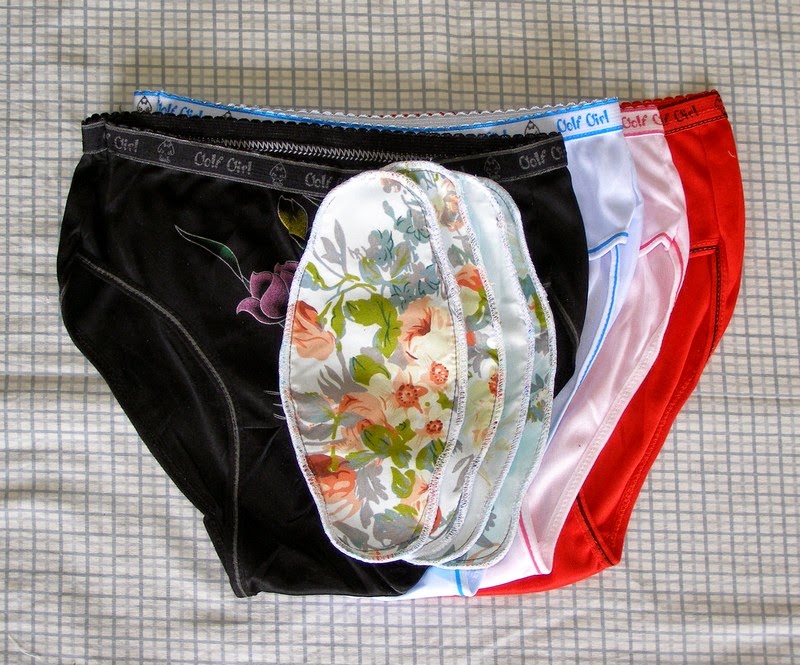
Each set of 4 pads and 4 knickers, delivered to the girl, costs 9,500 Uganda shillings, roughly £2.21. We think that is rather good value for a life changing intervention!

Monday, 14 September 2015

Time to catch up, better late than never.


I have been very remiss in my blogging. It was December last year....... Well, no excuses. But I would like to give you a series of sketches of what I have been up to, starting with Pads.  You can expect further posts in the coming week or so on the Deaf, the Radio, Farming and Future Plans. 


Pads Project
This school had a 241 girls over 12. In the foreground is the stack of knickers needed for each to get four pairs. 
The main project I am involved with is providing washable sanitary pads for schoolgirls. I have written about this before, so you can scroll down through the blog or link to here or here to get the full low-down.

To date, this year we have visited 16 schools, 11 of which were 1st time visits. About 1450 girls are now equipped to go confidently to school.

In June we were invited at short notice, by an NGO called ActionAid, to provide pads for the girls of 10 schools at their expense and we have 4 of those remaining to visit in the next two weeks.

Then we can resume visiting our 'old' schools and providing for their 'new' 12 year olds.

This year, by the end of the final term, we should have made and distributed in excess of 10,000 pads and bought and distributed the same number of knickers.

Does it any difference? So far it has proved very difficult to get clear statistics. But anecdotally it is not hard to show and I have yet to come across anyone here who thinks we are wasting our time.

I spoke to a successful woman of around 40 years a few months ago who said that by the time she reached the end of secondary school, she was the only girl in the school. All the others had dropped out for various factors peculiar to gender. Foremost among these was the problems and embarrassment of dealing with periods in a mixed school, without sanitary materials. She was very enthusiastic about this project.

Tuesday, 2 December 2014

Kibong

It feels in some way appropriate that the name of the 24th and last school that we reached with the pads ministry this year has a certain ring of finality about it, “Kibong!”


Pads are handed out at Kibong Primary School.
The hill in the background feels closer than the picture shows.

As schools go it was rather pleasant; the school itself was fairly new and well maintained but the village is set on level ground nestling between a couple of rocky hills, giving it a more interesting aspect than almost all the others we have visited. Most of our schools are set in a relatively featureless, mainly flat landscape with only trees to draw the eye. It has to be said that the trees are often rather fine, in some ways reminiscent of an English woodland landscape only that, on closer inspection they are clearly not Oak, Ash or Chestnut. This is bush country, just a bit too dry to be jungle but allows a great variety of trees to flourish. So far, the agricultural land use is not so intensive that all the trees have been cleared; perhaps because the vast majority of land is still managed using man and woman power; oxen may be used for ploughing but are of no use for weeding or harvesting. There are currently still plenty of tracts of native bush, including mature trees, between the cultivated areas. Perhaps mechanisation or population pressure will change this in a generation or two. 

This man has sewn all but the first
small batch of pads this year!
But I digress. Whilst landscape and environment are important and interesting, it is the people that we are here to serve; for this work, that means schoolgirls. Now, I have explained at length before that equal opportunity in education for boys and girls is a good thing and this is really the first generation here in the rural North of Uganda that have had that opportunity; very many of the mothers of our girls and quite a lot of the fathers had no formal education at all. But when the girls come to puberty and get ambushed by their menstrual cycles, equality of opportunity begins to vaporise.

In the West, periods are a problem1 to be managed, supported by an obliging sanitary hygiene industry. Here, for girls in the mixed schools of rural Uganda, that turns into a week at home, starting with potential embarrassment, maybe shame, every cycle. Sanitary pads are available but at the cost of around two days income. What chance do the girls have of reaching their academic potential in these circumstances?


What you see is what they get.
So this year we have manufactured 10,399 washable sanitary pads, using 138m of polyester fleece, 233m of PVC sheet and 43 bedsheets. We have bought 10,368 pairs of knickers in 7 trips to Lira. It takes a whole day to journey to and from Lira, about 3 hours away, for my colleague Milly. Travelling early in the back of a truck, she buys up to 130 dozen knickers from a number of traders and always comes back with exactly the required number, despite never writing anything down!

We have visited 24 schools, providing 4 pads and 4 pairs of knickers to 2647 girls2. We have actually talked to 2200 girls; in every school there are some off sick, away at an athletics competition, excluded from failure to pay the PTA fee etc. And of course, at any time, there are some who are at home waiting for their period to pass.

All this was done as economically as possible, at a cost of £2.46 (3.68 $US) per child, paid for by interested individuals and churches in the UK, Australia and America. Thank you! You have helped these young people by solving one key life problem for them. They have plenty of other problems to face but solving this one gives them a good start in facing the others.

Notes.
1. Men tend to cautiously think that it is rather incorrect to call menstruation a 'problem', perhaps arguing it is a normal bodily function of healthy people; most women seem to disagree. I will go with the women on this!


2. If you do the maths you will find that dividing 10364 (knickers) by 4 gives 2591 girls, whereas we recorded 2647 girls. There were a very few cases when we arrived at a school and there were more girls than the school had informed us of and we had no backup stock. In these cases we reduced a few girls down to 3 and 3. This may account for the difference. But it remains an unsolved puzzle for the moment.